
- jacquelynchadmarcelin
-
 Jumat, 01 Februari 2013
 -
 0 Comments


Free Ebook
as a fantastic book will certainly act not just the reading material however likewise good friend for any type of condition. A little error that some individuals may typically do is underestimating analysis as a lazy task to undergo. While if you understand the benefits as well as breakthroughs of analysis, you will certainly not underestimate any more. But, there are still some people that really feel that so and also really feel that they do not need analysis in specific event.

Free Ebook
We might not be able to make you love reading, but will certainly lead you to love reading beginning with now. Publication is the window to open up the new globe. The world that you want remains in the much better phase and also level. World will certainly constantly lead you to even the status phase of the life. You understand, this is several of exactly how analysis will certainly provide you the generosity. In this situation, more books you find out more expertise you recognize, yet it could indicate additionally the birthed is complete.
If you truly wish to be smarter, analysis can be among the lots means to stimulate and realize. Many individuals who such as analysis will have much more knowledge and also experiences. Checking out can be a way to get info from economics, national politics, scientific research, fiction, literary works, religious beliefs, and several others. As one of the part of publication classifications, constantly comes to be the most desired book. Lots of people are definitely looking for this book. It indicates that numerous enjoy to read this kind of publication.
The factors that make you must review it is the relevant subject to the problem that you truly want now. When it's going to make better chance of reading products, it can be the method you should absorb the same ways. Yeah, the ways that you can delight in the moment by reviewing , the time that you could make use of to do good task, as well as the time for you to get exactly what this publication offers to you.
The means you read this book will depend upon exactly how you look and also think about it. Lots of people will have their minutes and characteristic to contrast as well as take into consideration concerning the book. When you have the concepts to come out with guide written by this expert author, you could have benefits of it. prepares to get in soft documents. So, locate your finest reading publication today and also you will obtain actually just what you anticipate.
Product details
File Size: 1627 KB
Print Length: 270 pages
Publisher: Oxford University Press; 1st edition (August 4, 2008)
Publication Date: August 4, 2008
Sold by: Amazon Digital Services LLC
Language: English
ASIN: B07J1PS2WS
Text-to-Speech:
Enabled
P.when("jQuery", "a-popover", "ready").execute(function ($, popover) {
var $ttsPopover = $('#ttsPop');
popover.create($ttsPopover, {
"closeButton": "false",
"position": "triggerBottom",
"width": "256",
"popoverLabel": "Text-to-Speech Popover",
"closeButtonLabel": "Text-to-Speech Close Popover",
"content": '
});
});
X-Ray:
Not Enabled
P.when("jQuery", "a-popover", "ready").execute(function ($, popover) {
var $xrayPopover = $('#xrayPop_6B5C2EDC56F011E99EA781D61C14F9D9');
popover.create($xrayPopover, {
"closeButton": "false",
"position": "triggerBottom",
"width": "256",
"popoverLabel": "X-Ray Popover ",
"closeButtonLabel": "X-Ray Close Popover",
"content": '
});
});
Word Wise: Enabled
Lending: Not Enabled
Screen Reader:
Supported
P.when("jQuery", "a-popover", "ready").execute(function ($, popover) {
var $screenReaderPopover = $('#screenReaderPopover');
popover.create($screenReaderPopover, {
"position": "triggerBottom",
"width": "500",
"content": '
"popoverLabel": "The text of this e-book can be read by popular screen readers. Descriptive text for images (known as “ALT textâ€) can be read using the Kindle for PC app if the publisher has included it. If this e-book contains other types of non-text content (for example, some charts and math equations), that content will not currently be read by screen readers.",
"closeButtonLabel": "Screen Reader Close Popover"
});
});
Enhanced Typesetting:
Enabled
P.when("jQuery", "a-popover", "ready").execute(function ($, popover) {
var $typesettingPopover = $('#typesettingPopover');
popover.create($typesettingPopover, {
"position": "triggerBottom",
"width": "256",
"content": '
"popoverLabel": "Enhanced Typesetting Popover",
"closeButtonLabel": "Enhanced Typesetting Close Popover"
});
});
Amazon Best Sellers Rank:
#684,837 Paid in Kindle Store (See Top 100 Paid in Kindle Store)
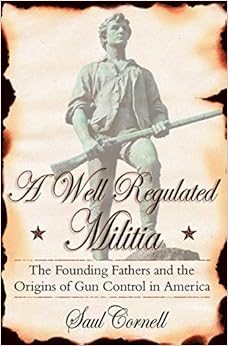
The Second Amendment to the United States Constitution is quoted every day by people who both favor and oppose gun ownership and use. A Well-Regulated Militia is a fascinating study into the meaning of the words of the Second Amendment both in their original context and how they have been reinterpreted over the years. It also explains the concept of self-defense as understood by the colonists, and how militias differed from standing armies, and why those differences were so important. America in the 1700s was a completely different place and you can get a glimpse into that world, and the evolution of the American experience, through this book. I recommend it to anybody who has strong opinions about guns in America.
A book that every gun owner should read and have.
No matter your stance on gun control and gun rights in America, the bias present throughout this book leaves it an unreliable source for historical events relevant to the Second Amendment. It appears to have motivated the author to conveniently leave out the cultural motivations for various rulings by the Supreme Court, allowing it to appear as if there has historically been a left-leaning slant due to an unspoken desire for gun control. As a side note, the author is fond of disregarding the connotation of a particular word to avoid sounding repetitive, making this an awkward read.
A tremendously informative book which is very difficult read, but well worth it. In spite of the excellent writing, I literally had to read every paragraph 4 or 5 times to fully understand its content.
This book provides a history of the gun control debate, going back to before the ratification of the Constitution. There really is nothing new under the sun. The books value is providing the background on positions (essentially three perspectives) taken today on the subject. It has all been hashed out several times in the past two hundred years. Interestingly the argument of today's opponents of gun control that their sacred 2nd. Amendment rights granted by the founders are being violated is of the most recent origin and really wasn't anywhere near the center of the argument in the late 18th Century. All in all it provides a source of well thought through arguments that if referenced will raise the current debate to a more scholarly tone than the from the gut wrenching, emotional tirades of today. The author does not preach or present a biased partisan view.
The five stars are sincere. It was just what I was looking for: an objective, well-written history of the 2nd amendment in American history. The organization is superb. It reads easily, with just enough background. Really a fascinating history. I was surprised that it ended before DC v. Heller, but this does not detract from the book at all. I was glad that he didn't know what was just around the corner.The objection from negative reviewers that the author was a stooge for special interests is absurd by any fair reading. I congratulate him for taking the time to write it, and for doing such a good job.I found the book browsing on Amazon and read it on a kindle.
This is not some dull constitutional law text. I gained a new perspective on American history as well as the evolution of the law regarding guns. The author proposes at the end of the book a sensible solution based on the historical development of the Second Amendment for protecting guns rights as well as crafting reasonable regulation for gun safety. The book is very readable. I'm glad I bought it.
Whatever you happen to believe about the original meaning of the Second Amendment is probably, if not altogether wrong, at least not altogether right. This, at least, is Saul Cornell's main contention in A Well Regulated Militia This is not because it is so hard to find out what people thought about the Second Amendment in 1790. It's just that so many people thought so many things that it is not really possible to reconstruct a coherent original understanding of the text. And even if we could, such an understanding would be based on a historical context that simply does not apply to America in the 21st century.Let's begin with that context. In the 18th century, local militias were kind of a big deal. Not only did most states and communities have them; most adult white males belonged to them, and were required to belong to them, as a condition of exercising other rights of citizenship. At this time, there was no standing army and no real professional police force. If a community wanted protection--from Indians, Redcoats, bad guys or whatever--the local militia had to provide it.And that's the way we liked it back then. Most people saw standing armies as instruments of tyranny. In Massachusetts and Virginia, the British governors had tried to disband militias, seize people's arms, and bring in professional soldiers (quartered in the homes of citizens) to provide protection. The colonists were not amused.The Second Amendment grew out of the concern that this sort of thing could happen again (so, too, did the Third Amendment, which forbids the quartering of soldiers in peacetime). When state legislators were petitioning the First Congress about possible amendments for the Bill of Rights, nearly all of them submitted amendments that would guarantee the right to bear arms AND prohibit a standing army during peace time. Federalist, who were unimpressed with the performance of the state militias during the Revolution, managed to fight off the objections to a standing army. To do this, however, they had to guarantee the perpetuity of state militias (and assure that soldiers would not be quartered in homes).What all of this gives us is a preamble to the Second Amendment that (translated into modern English) reads something like this: "Because a well-trained and well-provisioned militia is the only kind of security force consistent with the principles of a free Republic, the right of the people to keep and bear arms shall not be infringed." The key here is that serving in a militia was both a civic right and a civic responsibility, like voting or serving on juries. The two clauses in the Second Amendment emphasize both the civic duty ("a well regulated militia being necessary to the security of a free state") and the civil right ("the right of the people to keep and bear arms shall not be infringed.") The right and the duty are inseparable. To the eighteenth-century mind, they could not be otherwise.Most of the things that we now associate with the Second Amendment were not part of the original understanding but results of various battles and court cases in the nineteenth century. Among the most important of these are:The Individual Right to Self-Defense, which was recognized as a common-law right during the Founding era but not applied to the Second Amendment until the Jackson era. At that time, however, new State constitutions in Mississippi, Maine, Michigan, Missouri, and (a little bit later), Texas merged the Constitutional right to bear arms with the common-law right to self-defense in statements like: "the right to bear arms in defense of self and state." This gradually became the orthodox interpretation (and on many ways still is). However, during Reconstruction, many Southern States rejected the Individual Rights approach to the Second Amendment in favor of a Collective Rights approach that rejected any individual Constitutional right to bear arms. They did so primarily because freed slaves were demanding the right to exercise their right to bear arms. Nonetheless, the Reconstruction-Era Theory of Collective Rights became the dominate liberal approach to the Second Amendment in the 20th centuryThe Collective Right of Resistance, or the belief that the right to bear arms gave state or local militias the right to resist federal tyranny. Anti-federalists in the First Congress wanted something like this in the Bill of Rights, but Federalists did not go out of their way to give it to them. According to Cornell, this is first used as a legal argument in the aftermath of Dorr's Rebellion (against the State of Rhode Island) in 1842. The Court, under the direction of Supreme Court Justice Joseph Story flatly rejected this argument that any part of the Constitution conveyed a right of rebellion.The Individual Right of Revolution: The view that the Second Amendment was designed to give individuals (as opposed to state or community militias) the right to resist the tyranny of the state--completely unheard of in the Founding Era--has become something of an article of faith among gun-rights advocates in the 20th century. Cornell does an excellent job tracing this conception back to the 1850s and the abolitionist movement. This view finds expression in the abolitionist writings of Henry Ward Beecher and its fulfillment in the raid of John Brown. It has never been upheld in any court, and most Constitutional scholars believe that it completely reverses the original understanding of the Second Amendment by transforming it from an encouragement of civic virtue to an implement of civic destruction. Nonetheless, according to a recent poll, 65% of Americans believe that this is the purpose of the Second Amendment.(IMPORTANT NOTE: The Founders clearly recognized the natural right of revolution, which they exercised themselves in the Declaration of Independence and the Revolutionary War. But this emphatically is not the same thing as the Constitutional right to revolution, which many people see--with no support from the Founders--in the Second Amendment today).So, where do we go from here. A lot of people think that we should base our interpretation of the Second Amendment on the "original intent" of the Founding Fathers. Could we do it? Sure. Here's how:1. Dismantle all branches of the American military2. Eliminate police forces3. Require all male citizens to own military weapons (i.e. eliminate the right NOT to bear arms)4. Allow government agents to record all weapons owned by citizens, to enter homes to inspect the weapons, and punish people for handling guns incorrectly.5. Require people to give up their own time every month to engage in unpaid military exercises (this, really, is what "well regulated" means)6. Require all citizens to bear arms in the defense of the common good, at the discretion of the executive and regardless of their personal beliefs, or face military discipline for insubordination7. Require everybody to sign a loyalty oath or lose the rights of citizenship, including the right to bear armsNone of these things, of course, is likely to happen. No modern American--liberal or conservative--would tolerate them. What this means, then, is that we are going to have to do what people did throughout the 19th and 20th centuries and interpret the Second Amendment in a way that makes sense for the context that we happen to live in. In his very eloquent final chapter, Saul Cornell recommends that we think about somehow reconnecting the civil right to bear arms with the civic virtue that doing so once entailed. Such an approach would recognize that people have a right to own guns, but that they also have a responsibility to "bear arms" in a way that contributes to, or at least does not detract from, the public good.I say let's do it.Michael AustinAuthor of That's Not What They Meant!: Reclaiming the Founding Fathers from America's Right Wing
PDF
EPub
Doc
iBooks
rtf
Mobipocket
Kindle


0 komentar: